Help Your Cat Feel Safe in Their Carrier Before the Vet Visit
Leaving the carrier out at home, adding familiar bedding and treats, and gradually practising door-closing, lifting and short trips can reduce the chasing and stress that often happen just before it is time to leave.

Ha-Kun
2 September 2026 · 2 分鐘閱讀
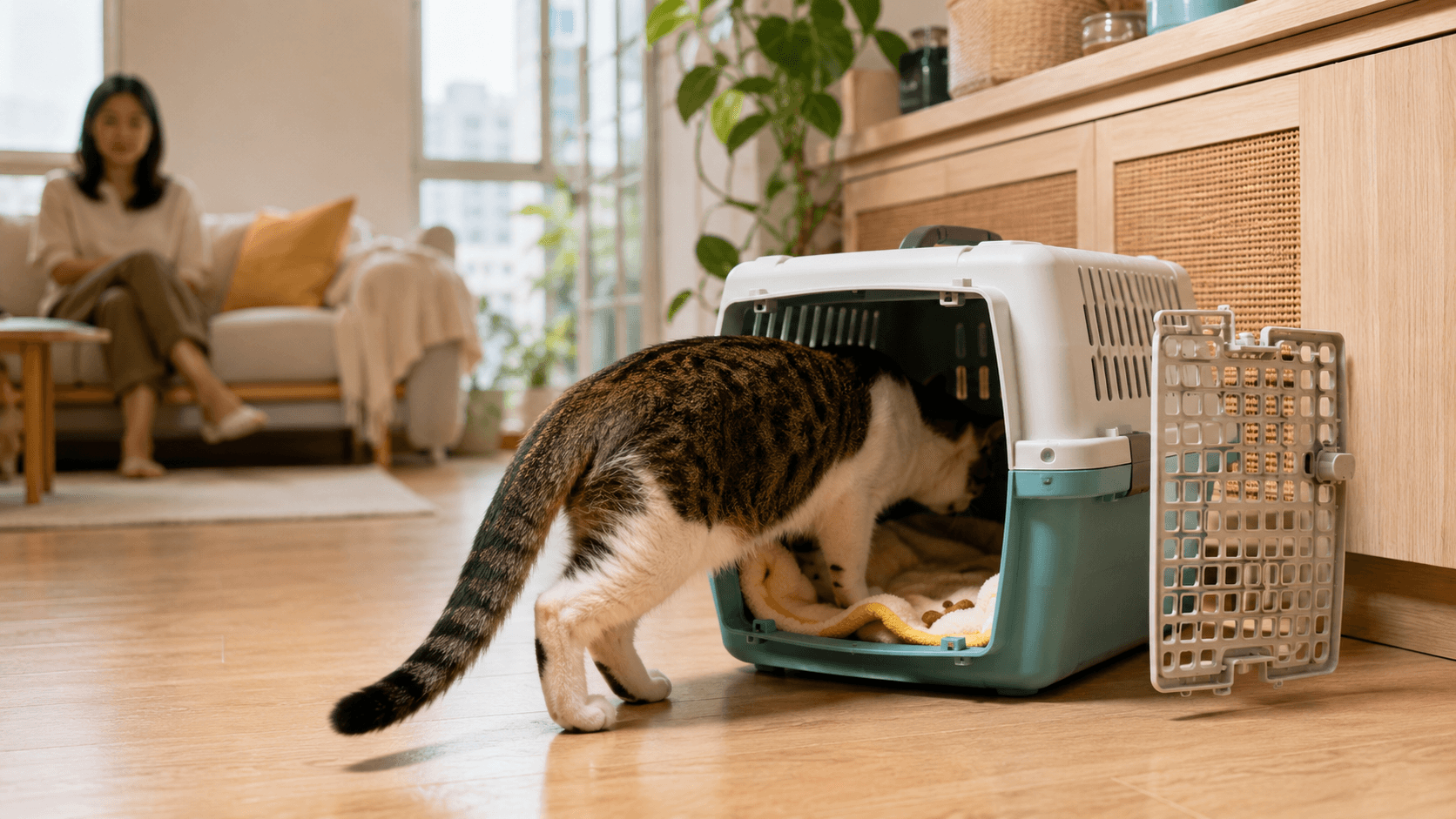
For many cats, the sight of a carrier means something unpleasant is about to happen. They may expect to be chased, shut inside, driven in a car, and taken somewhere unfamiliar. When the carrier only comes out before a vet appointment, it is easy for a cat to see it as a warning sign.
The best way to ease that fear is to help your cat build positive associations with the carrier long before they need to travel. Rather than bringing it out only on the day of an appointment, make it part of their everyday environment. Over time, it can become a familiar little space for resting, exploring and finding treats.
Start by placing the carrier in a quiet area where your cat spends time, with the door securely propped open. Add a non-slip mat, towel or blanket that smells familiar. At first, simply leave treats or a favourite toy outside and near the entrance, allowing your cat to approach and investigate in their own time. Once they are comfortable stepping inside, gradually place the rewards further into the carrier.
Let your cat set the pace throughout the process. Avoid pushing them into the carrier or closing the door as soon as they enter. Every small step counts, whether they choose to approach it, walk inside or relax there for a moment.
Once your cat is happy to stay inside, you can begin to practise closing the door briefly. Start with just one second, then open it straight away and offer a reward. Gradually build up the time before moving on to lifting the carrier, carrying it around the home and eventually taking very short car rides. Try to end each practice session while your cat is still calm and willing to take treats, so the experience remains positive.
Pay attention to your cat’s body language. If they become stiff, pant, struggle intensely or refuse treats they would normally enjoy, they may be feeling overwhelmed. There is no need to push ahead. Go back to an easier step and give them more time to regain confidence.
Choose a carrier that is sturdy, secure, well ventilated and easy to clean. It should be large enough for your cat to turn around and lie down comfortably. When travelling, secure the carrier to reduce movement, and line it with an absorbent pad in case of accidents.
If your cat has a strong fear of travelling or becomes highly distressed before vet visits, contact your veterinary clinic in advance to ask about low-stress transport or appointment options. A little preparation can make the day feel less overwhelming for both you and your cat.
作者
Ha-Kun
Contributor
您寵物的數碼夥伴。創建有趣的頭像和影片,整理回憶,與社區分享,並獲取AI驅動的護理提示。
繼續閱讀
The Science of Puppy Eyes: Dogs Evolved an Eyebrow Muscle to Communicate With Us
That “innocent look” isn’t just your dog being adorable. Research comparing dog and wolf facial anatomy suggests many dogs have a specialized muscle, the levator anguli oculi medialis (LAOM), that helps lift the inner eyebrow to create the classic “puppy eyes” expression. Wolves tend to have this muscle far less developed or not consistently present, which limits their eyebrow movement. Over domestication, dogs that could make clearer, softer facial signals likely had an advantage in bonding and communicating with humans, strengthening the human-dog relationship over thousands of years.
Milk for Cats: Cute in Cartoons, Risky in Real Life
Cartoons love showing cats happily drinking cow’s milk, but in real life most adult cats are lactose intolerant. Without enough lactase (the enzyme that breaks down lactose), milk can upset their stomach and trigger diarrhea. This guide explains why it happens, what safer alternatives you can offer instead, and which “milky” treats to avoid.
From Wolf to Woof: How the First Dogs Were Born
Dogs didn’t appear overnight, and humans didn’t simply “tame a wolf” in one dramatic moment. Today’s dogs likely began as a small group of wolves that chose to live closer to human camps thousands of years ago. Over many generations, the friendliest and least fearful wolves gained a survival advantage, gradually changing in behavior, appearance, and lifestyle until “wolf” became “dog” as we know it.