Do Dogs or Cats Understand Human Expressions Better?
Dogs often seem to notice the moment something is wrong, while cats may appear completely unbothered. So which one is actually better at reading human facial expressions? Research currently gives dogs a slight lead, but cats are paying much more attention than they let on.

Ha-Kun
9 September 2026 · 3 min read
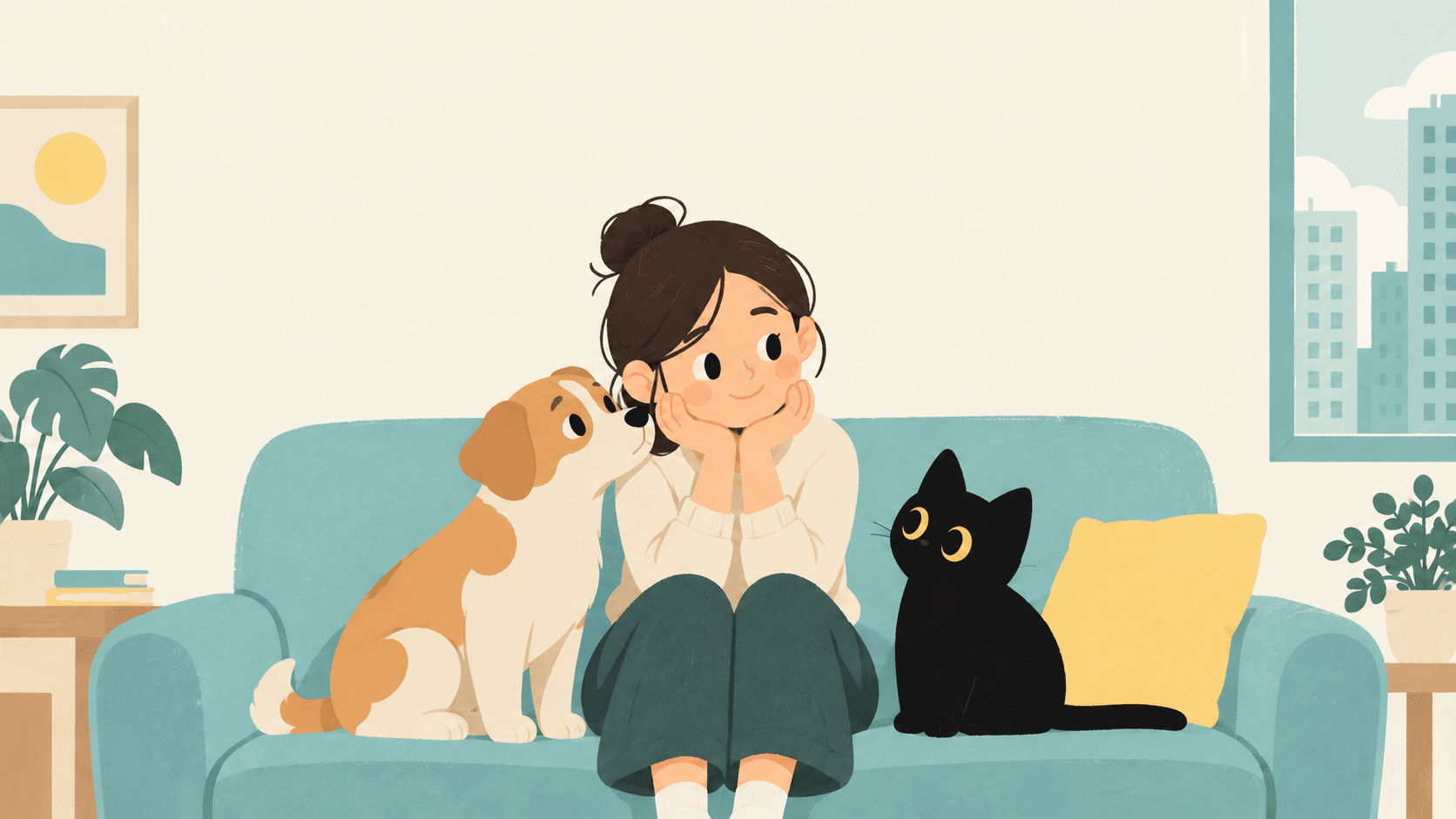
Have you ever been feeling low when your dog suddenly came over and leaned against you? Or frowned for a moment, only to watch your cat quietly turn away?
It is easy to feel that our pets understand our expressions. But whether dogs or cats are better at reading them is not as straightforward as it sounds.
Are dogs better at reading human expressions?
Based on the research available so far, dogs do seem to have a slight edge. There are more studies supporting this idea, and their findings are more consistent.
Researchers have trained dogs to distinguish happy human faces from angry ones. Even when the dogs could see only the top or bottom half of a face, they could still tell the two expressions apart. Other experiments suggest that dogs do not look at faces in isolation. They also take a person's expression and tone of voice into account.
When you smile and speak in a relaxed tone, your dog receives several positive cues at once. If your face is tense and your voice is lower than usual, they may notice that something feels different.
Does that mean cats do not understand?
Not at all.
Research suggests that cats also respond differently to positive and negative emotional signals from people. They pay particular attention to people they know well, such as the person they live with every day. Cats can also link facial expressions with vocal cues when making sense of the emotion in front of them.
Their response is often less obvious, though. A dog may come closer, wag their tail, or change posture straight away. A cat may simply watch you for a little longer, turn their ears, slow down, or keep some distance.
That does not mean they have missed what you are feeling. They may simply respond in a way you did not expect.
So are dogs definitely better at understanding us?
For now, there is more consistent evidence that dogs can distinguish human facial expressions. But researchers have not yet used the same methods to make a direct, like-for-like comparison between cats and dogs. It would therefore be too simple to say that every dog understands people better than every cat.
Cats and dogs also have different histories with humans, different social habits, and different ways of communicating. Dogs are usually more likely to seek a response from people. Cats are more likely to watch the situation first, then decide whether to come closer.
In everyday life, they are not relying on your face alone. Your voice, movements, scent, routines, and even the way you pick up the bag before going out all give them clues about what is happening.
You can make yourself easier for your pet to read
You do not need to exaggerate your facial expressions to test your pet. Clear and consistent communication is more likely to help them feel safe.
Try to keep your voice calm and avoid sudden, rushed movements. If you notice a stiff body, ears held back, rapid tail movements, avoidance, or nose licking, pause and give them a little space.
Your pet may not be able to name an emotion, but they are good at remembering what usually happens after you make a certain face or use a certain tone.
So when you think they have not noticed anything, they may already have picked up on the smallest change in your expression.
Written by
Ha-Kun
Contributor
Your pet's digital companion. Create fun avatars & movies, organize memories, share with the community, and get AI-powered care tips.
Keep reading
Snoring Is Not Always Cute: Breathing Signs in Flat-Faced Dogs
Some flat-faced dogs naturally make more breathing noise than others, but frequent snoring is not always harmless. Trouble recovering after exercise, disturbed sleep, or overheating should be checked by a veterinarian.

Why Does Your Dog Follow You Everywhere?
Following you from room to room can be a normal sign of companionship, curiosity, or a hope for food or play. The important question is how your dog behaves when you are apart.

Cat Disappears When Guests Arrive? Hiding Can Be a Healthy Choice
When visitors arrive, many cats feel safer watching from a distance or hiding completely. Instead of bringing them out to meet everyone, give them a quiet place where they can choose when, or if, to reappear.